Skip to content

In today’s electronics industry, switching power supplies are everywhere. Whether inside industrial automation equipment, CNC machinery, LED systems, telecommunications infrastructure, medical devices, or renewable energy systems, almost every modern electronic product depends on a reliable switching mode power supply (SMPS) to operate safely and efficiently.
Yet many buyers, engineers, and even equipment manufacturers still focus only on voltage and wattage when selecting a power supply. In reality, the true performance of a switching power supply is determined by something much deeper: the quality and design of its internal components.
The efficiency, thermal performance, EMI suppression capability, lifespan, and long-term stability of a power supply are all directly related to the components used inside the system. High-quality MOSFETs, optimized magnetic components, industrial-grade capacitors, advanced PWM control circuits, and carefully designed protection systems are what separate a professional industrial power supply from a low-cost commercial unit.
This article provides a complete breakdown of the most important components found inside modern switching power supplies, explains how they work together, and explores how industrial-grade platforms such as SIPURUI power supplies achieve higher reliability and efficiency in demanding applications.
What Is a Switching Power Supply and Why Is It So Widely Used?
A switching power supply converts electrical energy through high-frequency switching technology instead of using traditional linear voltage reduction methods. Unlike linear power supplies, which dissipate excess voltage in the form of heat, switching power supplies rapidly switch semiconductor devices on and off at high frequency to regulate output voltage efficiently.
This operating principle dramatically improves energy conversion efficiency while reducing physical size and thermal loss. As a result, switching power supplies have become the global standard across nearly all industries.
Compared with traditional linear power supplies, modern SMPS systems offer several major advantages:
- Much higher efficiency
- Smaller physical size
- Lower operating temperature
- Higher power density
- Wider input voltage range
- Better adaptability to industrial environments
These advantages are especially important in industrial automation and smart manufacturing, where equipment reliability, compact system design, and energy efficiency have become critical requirements.
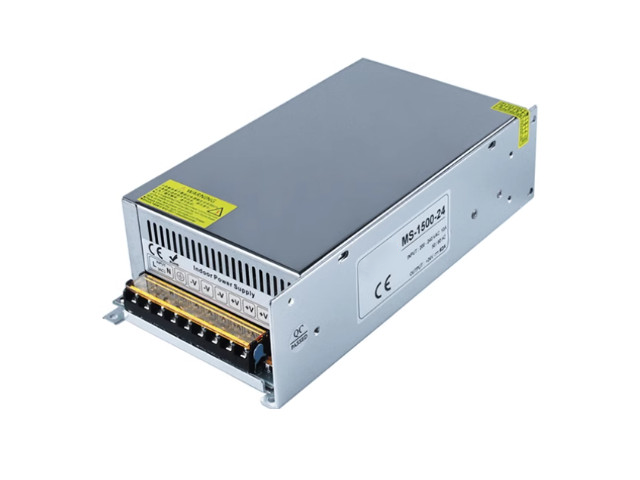
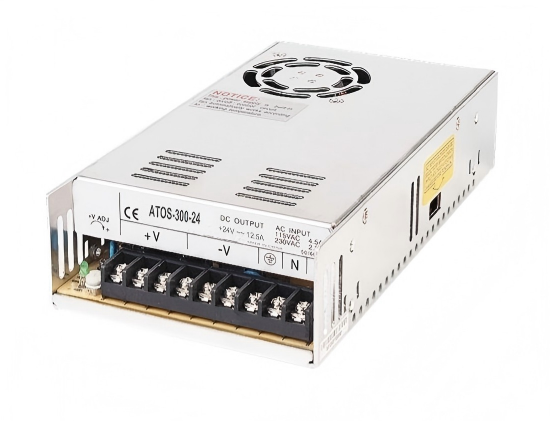
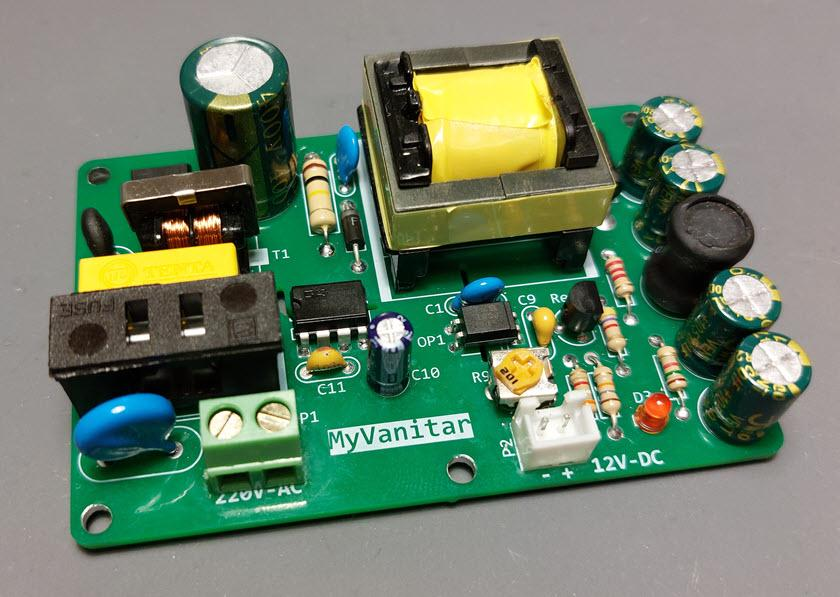
The following image shows the internal layout of a typical industrial switching power supply, including the major functional areas such as EMI filtering, high-frequency transformation, switching transistors, and output filtering circuits.

Why Is the Input Protection Stage So Important?
Before electrical energy can be converted and regulated, it must first pass through the input protection and filtering stage. This section is often underestimated, yet it plays a critical role in the long-term reliability of the entire power supply.
Industrial electrical environments are rarely stable. Voltage spikes, lightning surges, electrical noise, and inrush current events can all damage sensitive semiconductor devices almost instantly if no protective circuitry exists at the input stage.
To solve these problems, switching power supplies include several dedicated protection components.
The fuse is usually the very first safety component encountered by incoming power. Its purpose is straightforward but extremely important. If excessive current flows through the system because of a short circuit or internal component failure, the fuse disconnects the circuit before severe damage occurs. Industrial-grade power supplies often use ceramic slow-blow fuses because they can tolerate temporary startup surges while still providing excellent protection during fault conditions.
Another essential component is the MOV, or Metal Oxide Varistor. Electrical grids frequently experience voltage transients caused by lightning strikes, switching operations, or unstable industrial equipment. The MOV absorbs these dangerous voltage spikes before they reach sensitive power semiconductors such as MOSFETs and PWM control ICs.
Modern industrial power supplies like SIPURUI systems often integrate reinforced surge protection circuits to improve durability in harsh factory environments.
How Does EMI Filtering Improve Power Supply Reliability?
One of the defining characteristics of switching power supplies is high-frequency switching operation. Although this technology enables high efficiency and compact size, it also creates electromagnetic interference (EMI).
Without proper filtering, this electrical noise can interfere with nearby equipment, communication systems, and industrial control circuits. In severe cases, products may fail EMC certification requirements entirely.
To prevent these issues, switching power supplies include dedicated EMI filtering circuits at the input stage.
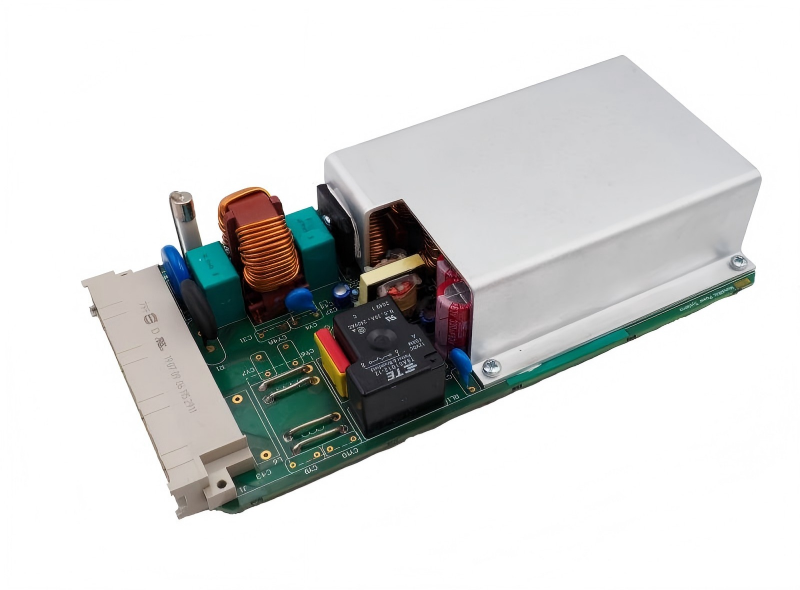
The image below illustrates a professional EMI filtering structure commonly used in industrial SMPS platforms.

The EMI filter usually consists of several key components working together.
The common mode choke suppresses high-frequency common-mode noise generated during switching operations. This magnetic component is critical for reducing conducted EMI and improving overall EMC performance.
X capacitors are connected between the live and neutral lines to suppress differential-mode noise, while Y capacitors connect the input lines to ground to reduce common-mode interference. Because Y capacitors directly affect leakage current and user safety, they must comply with strict international safety standards.
High-quality EMI filtering not only improves compliance with standards such as CISPR and EN55032, but also significantly enhances long-term system stability in industrial applications.
Why Is the Power Conversion Stage Considered the Core of the SMPS?
Once the input voltage has been filtered and rectified into DC, the power conversion stage takes over. This is the heart of the switching power supply, where actual energy conversion occurs.
The overall efficiency, thermal behavior, power density, and reliability of the power supply are largely determined by the quality of this stage.
At the center of the conversion stage is the MOSFET.
MOSFETs act as ultra-fast electronic switches that continuously turn on and off at frequencies ranging from tens of kilohertz to several hundred kilohertz. In modern GaN-based designs, switching frequencies can even exceed one megahertz.
The reason for using such high frequencies is simple: higher switching frequency allows the use of much smaller transformers and magnetic components. This dramatically reduces the overall size and weight of the power supply.
However, high-frequency switching also creates new engineering challenges, including switching losses, heat generation, and EMI control. This is why high-quality industrial power supplies require carefully optimized switching topologies and thermal management systems.
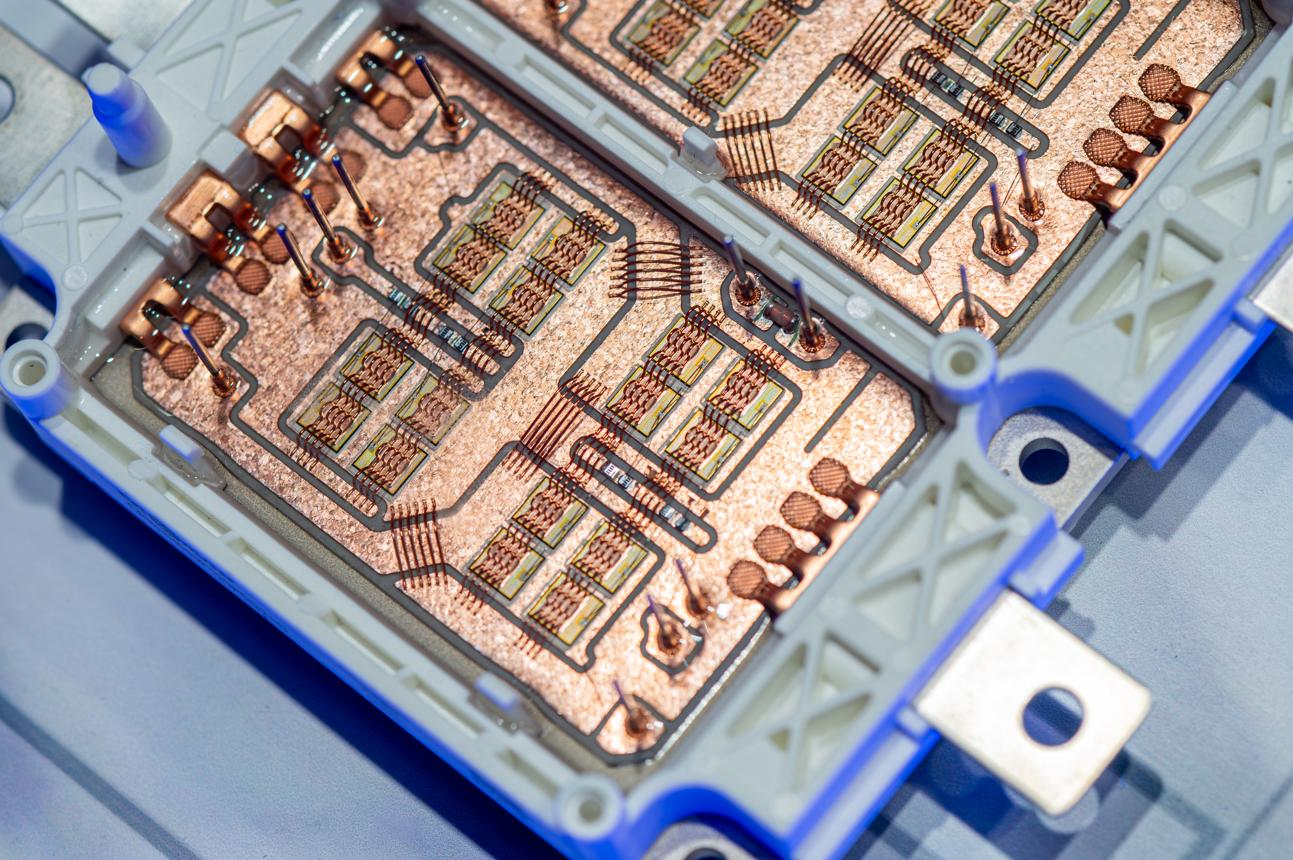
The following image shows a typical high-frequency switching power supply schematic and transformer structure.
In most industrial power supplies below 2kW, MOSFETs are preferred over IGBTs because of their faster switching speed and superior efficiency at high frequencies. IGBTs are still widely used in extremely high-power applications such as industrial inverters and welding systems, where voltage and current requirements are significantly higher.
Another essential component in this stage is the high-frequency transformer. Unlike traditional 50Hz transformers, high-frequency transformers operate at much higher frequencies, allowing them to be dramatically smaller while still transferring substantial amounts of energy.
The transformer performs several important functions simultaneously:
- Voltage conversion
- Electrical isolation
- Energy transfer
Transformer design directly affects power supply efficiency, EMI performance, thermal behavior, and reliability. This is why industrial manufacturers invest heavily in transformer optimization.
Why Are Schottky Diodes and Synchronous Rectification So Important?
During switching operation, energy stored inside inductors must continue flowing when the MOSFET turns off. This requires freewheeling or rectification components.
Traditional designs commonly use fast recovery diodes or Schottky diodes. Schottky diodes are especially popular in low-voltage outputs because they offer lower forward voltage drop and reduced switching losses compared with conventional diodes.
However, as efficiency requirements continue increasing, many modern industrial power supplies now use synchronous rectification technology instead.
Synchronous rectification replaces output diodes with MOSFETs. Since MOSFET conduction losses are significantly lower than diode losses, this approach can greatly improve efficiency and reduce heat generation.
This technology is now widely used in high-end industrial systems, telecom power supplies, server power systems, and fast-charging platforms.
SIPURUI high-efficiency power supply series use synchronous rectification technology to achieve conversion efficiencies exceeding 94%, helping reduce operating temperature while improving overall system lifespan.
How Does the Control Circuit Keep Output Voltage Stable?
Stable output voltage is one of the most important requirements in any switching power supply. Without accurate regulation, connected equipment may malfunction, overheat, or become permanently damaged.
The component responsible for maintaining stable operation is the PWM controller.
PWM stands for Pulse Width Modulation. The PWM control IC continuously monitors output voltage and dynamically adjusts the switching duty cycle of the MOSFETs to maintain stable output conditions.
Widely used PWM ICs include:
| PWM Controller | Typical Application | Main Advantage |
| UC3842 | Flyback converters | Cost-effective and reliable |
| TL494 | Industrial control systems | Mature architecture |
| SG3525 | Push-pull and bridge systems | High-power capability |
| NCP1200 | Compact adapters | Low standby power |
In isolated power supplies, feedback information must safely travel from the output side back to the primary control circuit. This is accomplished through an optocoupler.
An optocoupler transfers signals using light instead of direct electrical conduction, ensuring safe isolation between high-voltage and low-voltage sections.
The TL431 precision regulator is commonly paired with the optocoupler to create highly accurate voltage feedback systems. Despite the development of digital power technologies, TL431-based analog feedback circuits remain extremely popular because of their low cost, excellent precision, and long-term stability.
Why Are Output Capacitors So Critical to SMPS Performance?
Even after voltage conversion and rectification, switching power supplies still contain high-frequency ripple and electrical noise. Output filtering components are responsible for smoothing the DC output and stabilizing transient response.
The most important filtering components are output capacitors.
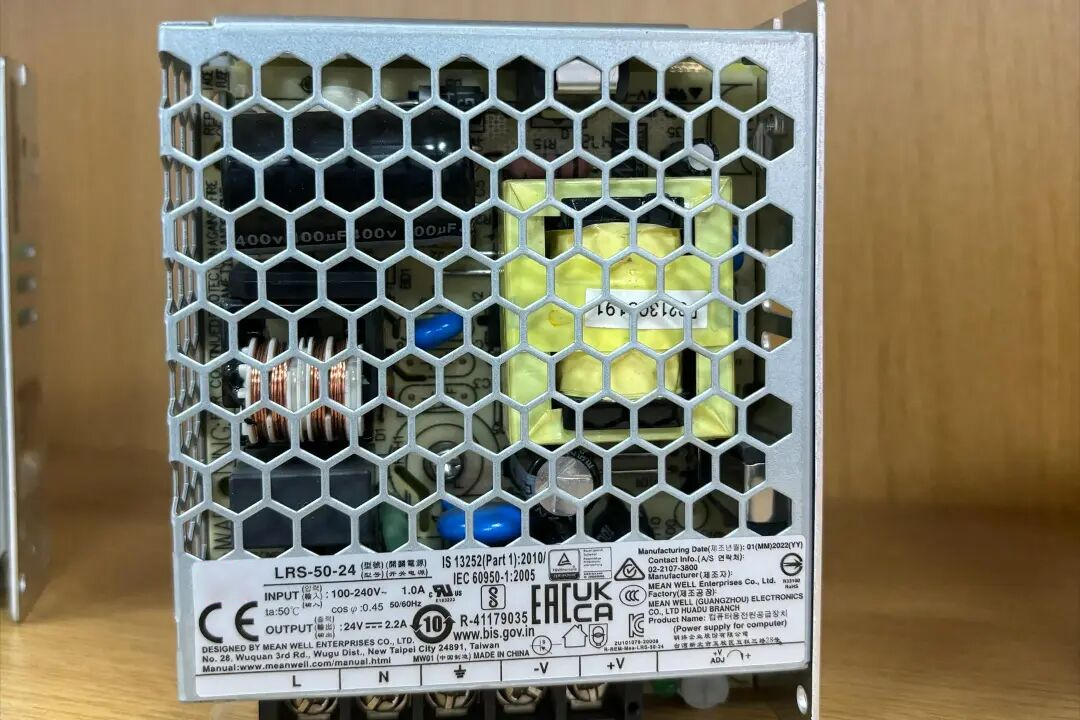
The following image shows a typical output filtering section inside an industrial switching power supply.
Different capacitor technologies offer different advantages.
| Capacitor Type | Main Advantage | Typical Use |
| Aluminum Electrolytic | High capacitance | Bulk energy storage |
| Solid Capacitor | Low ESR and long lifespan | Industrial systems |
| MLCC Ceramic | Excellent high-frequency filtering | Fast transient response |
One of the most important capacitor characteristics is ESR, or Equivalent Series Resistance.
Lower ESR results in:
- Lower ripple voltage
- Reduced heat generation
- Better efficiency
- Longer lifespan
This is why high-quality industrial power supplies increasingly use low-ESR capacitor solutions.
Why Are Protection Circuits Essential in Industrial Power Supplies?
Industrial power supplies must operate safely under unpredictable load conditions. Overload, overheating, short circuits, and abnormal voltage conditions are all possible in real-world environments.
To prevent catastrophic failure, modern power supplies integrate multiple protection mechanisms.
Overcurrent Protection (OCP) monitors output current using current-sensing resistors. If current exceeds safe operating limits, the PWM controller shuts down switching operation.
Overvoltage Protection (OVP) prevents dangerous voltage spikes from reaching connected equipment, which is especially important for industrial automation systems and telecommunications infrastructure.
Overtemperature Protection (OTP) uses thermistors to monitor internal temperatures. If thermal conditions become unsafe, the power supply automatically shuts down to prevent damage.
SIPURUI industrial switching power supplies integrate comprehensive OCP, OVP, and OTP protection systems combined with optimized airflow and thermal management structures for maximum long-term reliability.
Why Is Active PFC Becoming Standard in Modern Industrial Power Supplies?
Power Factor Correction (PFC) has become increasingly important in industrial power design.
Without proper PFC, electrical systems experience:
- Higher harmonic distortion
- Poor energy utilization
- Increased stress on the electrical grid
Active PFC technology solves these issues by shaping the input current waveform to closely match the input voltage waveform.
| Feature | Passive PFC | Active PFC |
| Power Factor | 0.7–0.8 | 0.95–0.99 |
| Efficiency | Moderate | High |
| Size | Larger | Smaller |
| Industrial Compatibility | Limited | Excellent |
Most modern SIPURUI industrial power supply platforms use active PFC topology to achieve high efficiency and excellent grid compatibility.

What Technologies Are Defining the Future of Switching Power Supplies?
The SMPS industry continues evolving toward higher efficiency, smaller size, and greater power density.
Two semiconductor technologies are driving this transformation.
GaN (Gallium Nitride) devices offer ultra-fast switching capability with extremely low switching losses. These devices are increasingly used in compact high-density power systems and advanced fast chargers.
SiC (Silicon Carbide) devices provide superior high-voltage and high-temperature performance, making them ideal for EV charging systems, renewable energy equipment, and industrial inverters.
As these technologies continue maturing, future switching power supplies will become even smaller, cooler, and more efficient.
Final Thoughts
A switching power supply is far more sophisticated than most people realize. Behind every stable DC output lies a carefully engineered combination of protection circuits, switching semiconductors, magnetic components, filtering systems, and intelligent control architectures.
The quality of these internal components directly determines the efficiency, reliability, thermal performance, and operational lifespan of the power supply.
For industrial manufacturers, OEM buyers, and equipment designers, understanding these components is essential when selecting reliable power solutions for demanding applications.
With advanced engineering, optimized thermal design, industrial-grade components, and high-efficiency architectures, SIPURUI switching power supplies are designed to deliver the long-term reliability required in modern industrial environments.