In today’s electronics-driven world, one question quietly determines whether a system runs flawlessly or fails prematurely: is your power supply truly reliable?
Switching power supplies (SMPS) have become the backbone of modern electrical systems, powering everything from CNC machines and industrial robots to telecom infrastructure and medical devices. But with hundreds of brands and thousands of models available, how do you separate marketing claims from real engineering performance?
This guide goes beyond generic explanations. It dives into real-world applications, proven global brands, and specific product series, helping engineers, buyers, and OEM manufacturers make informed decisions based on performance—not hype.
What Makes Switching Power Supplies So Critical Today?

Why have switching power supplies replaced traditional linear power supplies in nearly every serious application?
The answer lies in efficiency and adaptability. Traditional linear power supplies dissipate excess energy as heat, often achieving efficiencies below 60%. In contrast, modern SMPS designs routinely exceed 90% efficiency, dramatically reducing energy loss and thermal stress.
But efficiency is only part of the story. Switching power supplies are also:
- Compact and lightweight due to high-frequency operation
- Capable of wide input voltage ranges (often 85–264VAC)
- Designed with advanced protection features (OVP, OCP, SCP)
- Highly adaptable to industrial, medical, and telecom environments
In high-demand systems like CNC machining centers or automated production lines, even small voltage instability can result in production errors or equipment damage. That’s why power quality is no longer optional—it’s mission-critical.
Are All Switching Power Supplies Built the Same?
At first glance, many power supplies appear similar. They may share the same voltage rating, wattage, or form factor. But internally, the differences can be substantial.
The real differentiators lie in:
- Component quality (capacitors, transformers, MOSFETs)
- Thermal design and derating curves
- EMI/EMC performance
- Protection circuitry sophistication
- Certification compliance (UL, CE, IEC60601, etc.)
A low-cost unit might meet basic specifications under ideal conditions, but how does it perform at 50°C ambient temperature? How does it handle voltage spikes or continuous 24/7 operation?
These are the questions that separate consumer-grade power supplies from industrial-grade solutions.
Global Switching Power Supply Brands: Who Can You Trust?
MEAN WELL — The Benchmark for Industrial Value

When discussing switching power supplies globally, MEAN WELL is often the first name mentioned—and for good reason. The company offers one of the most extensive product portfolios in the industry, covering power ranges from a few watts to over 10kW.
Popular series include:
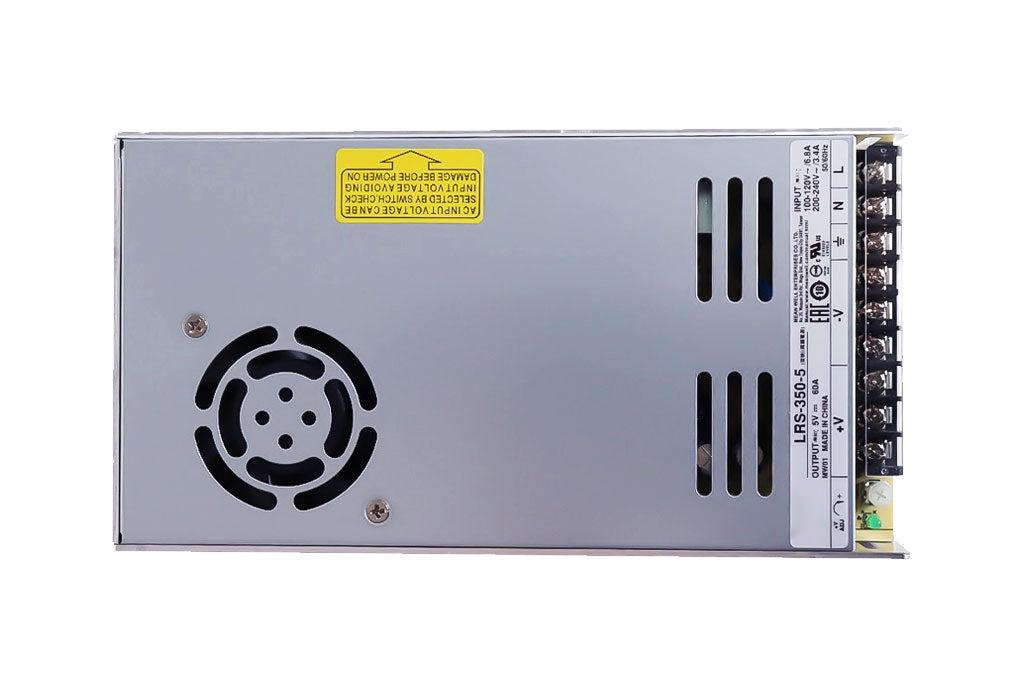
- LRS Series: Cost-effective enclosed power supplies (e.g., LRS-350-24)
- NDR Series: DIN rail solutions for industrial automation
- RSP Series: High-power applications up to 3000W
MEAN WELL’s strength lies in its balance of cost and reliability, making it ideal for general industrial applications, LED systems, and export-oriented equipment.

TDK-Lambda — High-End Performance and Precision

If your application demands exceptional reliability—such as medical systems or telecom infrastructure—TDK-Lambda stands out.
Notable product lines:
- DRF Series: DIN rail power supplies for industrial environments
- CUS Series: Medical-grade power supplies
- GENESYS+ Series: Programmable high-performance power systems
Their products are known for outstanding EMI suppression and long operational lifespans, often exceeding 10 years under proper conditions.

Delta Electronics — Powering Global Infrastructure
Delta Electronics is one of the largest power supply manufacturers in the world, with strong integration across automation, EV, and data center sectors.
Key series include:
- PMT Series: Compact DIN rail power supplies
- CliQ Series: Industrial automation solutions
- Server PSU platforms: Used in hyperscale data centers
Delta’s strength lies in scalability and efficiency, often achieving 94%+ efficiency in high-power designs.
Cosel — Reliability for Harsh Environments
Cosel focuses heavily on durability and long-life design. Their power supplies are frequently used in railway, factory automation, and semiconductor equipment.
Typical series:
- PBA Series: Enclosed power supplies
- HFA Series: High-efficiency industrial PSU
Cosel products often feature conservative thermal design, ensuring stability even under continuous heavy loads.
TRACO POWER — Specialists in Modular Power
TRACO POWER is particularly strong in DC/DC converters and compact modules.
Well-known series:
- TXN Series: Industrial AC/DC power supplies
- TEN Series: Compact DC/DC modules
- TEP Series: Medical-grade encapsulated units
These products are widely used in embedded systems and communication equipment where space and reliability are critical.
How Do These Brands Compare?
Brand Comparison Overview
| Brand | Origin | Key Strength | Typical Applications | Efficiency Range |
| MEAN WELL | Taiwan | Cost-performance balance | Industrial, LED, automation | 85–92% |
| TDK-Lambda | Japan | High reliability | Medical, telecom | 90–94% |
| Delta | Taiwan | Large-scale efficiency | Data centers, automation | 90–96% |
| Cosel | Japan | Long lifespan | Harsh industrial environments | 88–93% |
| TRACO POWER | Switzerland | Compact modular design | Embedded, medical | 85–92% |
How Should You Choose the Right Power Supply?
Choosing a switching power supply is not just about matching voltage and current. It requires a deeper understanding of system demands.
Power Selection Reference
| Device Type | Typical Voltage | Power Range | Recommended Margin |
| PLC Systems | 24V | 50–200W | +25% |
| CNC Machines | 24V / 48V | 200–1000W | +30% |
| LED Systems | 12V / 24V | 100–600W | +20% |
| Telecom Equipment | 48V | 500–3000W | +30% |
A key principle often overlooked is derating. Power supplies should not operate continuously at full load. Running at 70–80% capacity significantly extends lifespan and improves thermal stability.
What About Efficiency and Heat?
Efficiency is directly linked to reliability. A 90% efficient power supply wastes 10% energy as heat. In a 1000W system, that’s 100W of heat—equivalent to a small heater inside your equipment.
Table 3: Efficiency vs Heat Loss
| Power Output | Efficiency | Heat Loss |
| 500W | 85% | 75W |
| 500W | 90% | 50W |
| 1000W | 92% | 80W |
| 1000W | 95% | 50W |
Higher efficiency not only reduces energy costs but also minimizes cooling requirements and extends component lifespan.
Where Do Most Failures Actually Come From?
Contrary to common belief, most power supply failures are not due to design flaws—but improper selection.
Typical causes include:
- Operating at full load continuously
- Poor ventilation or high ambient temperature
- Ignoring surge and transient conditions
- Using non-certified or low-quality units
In industrial environments, a failed power supply can halt an entire production line. The cost of downtime often far exceeds the cost difference between a low-end and a premium PSU.

Final Thoughts: What Should You Prioritize?
So, what really matters when choosing a switching power supply?
Not just price. Not just specifications on paper.
The real priorities are:
- Stability under real-world conditions
- Proven brand reliability
- Proper power margin
- Certification compliance
- Thermal and efficiency performance
If your application is general industrial use, brands like MEAN WELL or Delta offer excellent value. For high-end or mission-critical systems, TDK-Lambda and Cosel provide unmatched reliability. And for compact or embedded systems, TRACO POWER and Murata deliver strong modular solutions.
Ultimately, the best power supply is not the cheapest—it is the one that keeps your system running without failure.