Skip to content


The evolution of modern electronics has fundamentally changed the requirements placed on power conversion systems. As industrial equipment becomes more compact, computing systems become more powerful, and energy efficiency regulations become increasingly strict, conventional linear power architectures are no longer capable of meeting the demands of modern electronic design.
This transformation is one of the primary reasons switching power supplies have become the dominant AC/DC power solution across industrial, commercial, and consumer markets.
Whether in industrial automation systems, communication infrastructure, medical electronics, renewable energy equipment, or embedded control systems, switching power supplies now serve as the electrical backbone of modern devices. Their ability to deliver high efficiency, compact size, reduced thermal loss, and stable voltage regulation has made them essential for nearly every advanced electronic application.
Unlike traditional linear power supplies, which regulate voltage by dissipating excess energy as heat, switching power supplies regulate energy through high-frequency switching technology. This difference may appear simple at first glance, but it fundamentally changes the way electrical energy is processed inside a power conversion system.
The result is dramatically higher efficiency, significantly smaller magnetic components, lower operating temperatures, and much higher power density.
As modern industries continue moving toward intelligent manufacturing, high-density automation, and energy-efficient infrastructure, switching power supplies are no longer viewed as secondary supporting components. Instead, they have become critical technologies directly affecting system reliability, operational efficiency, thermal stability, and long-term maintenance cost.
Why Traditional Linear Power Supplies Are No Longer Sufficient
For many years, linear power supplies were widely used because their operating principles were relatively straightforward. Incoming AC voltage was reduced through a low-frequency transformer, rectified into DC voltage, filtered, and stabilized through linear regulation stages.
Although this architecture provided relatively low electrical noise and simple circuit design, its efficiency limitations became increasingly problematic as electronic systems evolved.
The core issue lies in the regulation process itself. Linear regulators continuously dissipate excess voltage as heat. As output power increases, energy loss rises proportionally, forcing the system to rely on larger heatsinks and bulkier thermal structures.
This creates several major disadvantages in modern applications.
Linear vs Switching Power Supply
| Feature | Linear Power Supply | Switching Power Supply |
| Efficiency | 40%–60% | 85%–96% |
| Heat Generation | High | Low |
| Transformer Size | Large | Compact |
| Power Density | Low | High |
| Cooling Requirement | Large heatsinks | Minimal |
| Weight | Heavy | Lightweight |
In industrial environments where systems may operate continuously for years, poor efficiency directly translates into higher electricity consumption, increased internal temperature, faster component aging, and reduced operational reliability.
The physical size of linear transformers also creates significant integration challenges for compact electronic systems. As equipment manufacturers increasingly prioritize miniaturization and modular system design, traditional linear architectures become difficult to justify from both thermal and economic perspectives.
Switching power supplies were developed specifically to overcome these limitations.
How Switching Power Supplies Achieve High Conversion Efficiency
The defining principle behind switching power supplies is energy regulation through high-frequency switching rather than continuous voltage dissipation.
Instead of reducing voltage by converting excess electrical energy into heat, switching power supplies rapidly switch semiconductor devices between fully ON and fully OFF states. Because power loss is extremely low during these operating conditions, overall conversion efficiency improves dramatically.
Modern AC/DC switching power supplies typically process electrical energy through several coordinated stages, including rectification, filtering, power factor correction, high-frequency switching, transformer isolation, and closed-loop voltage regulation.
The first stage begins with converting incoming AC voltage into DC voltage.
AC to DC Rectification Stage

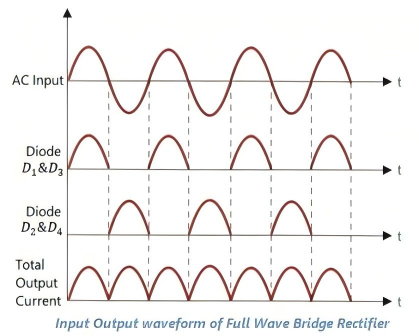
A bridge rectifier converts the alternating AC waveform into pulsating DC voltage. However, the output waveform at this stage still contains significant ripple components and cannot directly supply sensitive electronic circuits.
To stabilize the DC bus voltage, large electrolytic capacitors are connected after the rectifier stage. These capacitors temporarily store electrical energy during waveform peaks and release stored energy during voltage drops, smoothing the output waveform considerably.
The effectiveness of this filtering stage directly affects ripple voltage, system stability, electromagnetic interference, and overall power quality.
In industrial environments, poor ripple performance can create signal instability in communication systems, affect servo control accuracy, and reduce the lifespan of sensitive electronic components.
Modern SIPURUI switching power supplies utilize optimized low-ESR capacitor configurations and advanced filtering architectures to maintain stable output voltage even under fluctuating load conditions.
Typical Ripple Voltage Comparison
| Power Supply Type | Typical Ripple Voltage |
| Low-cost Linear Supply | 150–300mV |
| Standard Switching Supply | 50–100mV |
| SIPURUI Industrial Series | <30mV |
Low ripple performance is especially important in industrial automation systems, embedded controllers, communication equipment, and precision instrumentation where long-term electrical stability is critical.
Why Power Factor Correction Has Become Essential in Modern Power Systems
As switching power supplies became more widely adopted, another engineering challenge emerged: harmonic distortion caused by nonlinear current consumption.
Without correction, switching power supplies tend to draw current in short high-amplitude pulses rather than smooth sinusoidal waveforms. This behavior introduces harmonics into the electrical grid, reducing power quality and increasing electrical losses throughout the system.
In large-scale industrial facilities, poor power factor can significantly affect electrical infrastructure efficiency and increase thermal stress on distribution systems.
To solve this problem, modern switching power supplies incorporate Power Factor Correction (PFC) technology.
The purpose of PFC is to reshape the input current waveform so that it follows the input voltage waveform more closely. By improving waveform synchronization, harmonic distortion is reduced while energy utilization efficiency improves substantially.
Active PFC Architecture

Modern industrial switching power supplies primarily use active PFC circuits because they provide significantly better harmonic suppression and higher efficiency than passive filtering solutions.
Active PFC technology also helps industrial systems comply with increasingly strict EMC and harmonic regulations across global markets.
SIPURUI industrial switching power supplies integrate advanced active PFC architectures designed to improve grid compatibility while maintaining high conversion efficiency under demanding operating conditions.
Why High-Frequency Switching Fundamentally Changes Power Supply Design
One of the most important technological breakthroughs in switching power supplies is the adoption of high-frequency switching operation.
Traditional transformers operating directly from the utility grid function at 50Hz or 60Hz. At these low frequencies, transformers require large magnetic cores to prevent saturation, resulting in bulky and heavy power systems.
Switching power supplies eliminate this limitation by first converting AC voltage into DC voltage and then generating high-frequency switching waveforms through semiconductor switching devices.
These switching frequencies typically exceed 20kHz and may reach several hundred kilohertz in advanced designs.
As switching frequency increases, transformer size decreases dramatically.
Transformer Size Reduction Through Frequency
| Operating Frequency | Transformer Size |
| 50Hz | Very Large |
| 20kHz | Small |
| 100kHz | Ultra Compact |
This improvement is one of the primary reasons modern industrial power systems can achieve significantly higher power density while occupying much smaller installation space.
Higher switching frequency also improves transient response speed, enabling the power supply to react more quickly to changing load conditions.
For industrial automation systems with rapidly varying loads, this capability is extremely important for maintaining voltage stability and operational reliability.
The Critical Role of MOSFET Technology in Modern SMPS Design
The advancement of switching power supply technology is closely connected to the development of modern MOSFET semiconductor devices.
MOSFETs operate as extremely fast electronic switches capable of handling high voltage and current transitions while maintaining relatively low conduction losses. Their ability to switch efficiently at high frequencies enables the compact and high-efficiency architectures used in modern switching power supplies.
Industrial applications place particularly demanding requirements on switching devices. Power supplies may need to operate continuously under elevated ambient temperatures, fluctuating loads, voltage surges, vibration, and long operational cycles.
To ensure stable operation under these conditions, modern SIPURUI switching power supplies utilize optimized high-voltage MOSFET architectures designed specifically for industrial-grade thermal stability and long-term reliability.
The improvement of semiconductor switching devices has directly enabled higher operating frequencies, improved efficiency, smaller magnetic components, and greater overall power density across modern SMPS platforms.
Why LLC Resonant Converters Are Becoming the Preferred High-Power Topology
As switching power supplies move into higher power applications, switching losses become increasingly important.
Conventional hard-switching topologies generate greater thermal stress and electromagnetic interference as power levels rise. To improve efficiency under these conditions, many modern high-power power supplies now utilize LLC resonant converter topology.
Unlike conventional switching architectures, LLC resonant converters utilize soft-switching techniques that allow switching devices to transition when voltage or current approaches zero.
LLC Resonant Converter Structure

This significantly reduces switching losses while improving thermal performance and electromagnetic compatibility.
The result is a power conversion system capable of achieving:
- Higher efficiency
- Lower operating temperature
- Reduced EMI generation
- Improved long-term reliability
- Better high-power performance
Because of these advantages, LLC resonant architectures are increasingly used in telecom infrastructure, server systems, industrial automation equipment, and EV charging applications.
Modern SIPURUI high-power switching power supplies integrate LLC resonant designs specifically to improve efficiency and operational reliability under continuous industrial workloads.
Why Industrial Applications Demand More Advanced Power Architectures
Industrial environments place far greater demands on power systems than typical consumer electronics.
In industrial automation systems, switching power supplies may operate continuously for years inside control cabinets exposed to elevated temperatures, vibration, dust, electrical noise, and fluctuating load conditions.
Under these environments, power supply performance directly affects the stability of PLC systems, servo drives, communication networks, industrial sensors, and embedded controllers.
For this reason, industrial-grade switching power supplies must prioritize not only efficiency, but also thermal optimization, ripple suppression, protection systems, electromagnetic compatibility, and long-term operational stability.
SIPURUI industrial switching power supplies are engineered specifically for these demanding environments, combining high-efficiency conversion architectures, active PFC technology, low-ripple filtering, industrial-grade protection functions, and optimized thermal management into compact and reliable industrial platforms.
As intelligent manufacturing systems continue evolving, the importance of reliable high-performance power conversion will only continue increasing.

The Future of Switching Power Supply Technology
The next generation of switching power supplies is being shaped by rapid advancements in semiconductor technology.
Wide-bandgap materials such as Gallium Nitride (GaN) and Silicon Carbide (SiC) are enabling switching devices to operate at higher frequencies with lower switching losses and improved thermal performance compared with conventional silicon semiconductors.
These technologies are driving the development of smaller, lighter, and more efficient power systems with dramatically higher power density.
Future switching power supplies are expected to incorporate:
- Higher switching frequencies
- Digital power management
- AI-assisted energy optimization
- Intelligent thermal control
- Greater integration density
- Improved efficiency standards
As global industries continue prioritizing energy efficiency, compact system integration, and intelligent automation, advanced switching power technologies will remain central to the future of modern electronics.