Skip to content

The Real Reasons Factories Prefer 24V Switching Power Supplies Over 12V or 48V
In industrial automation, few standards are as universally accepted as 24V DC power. Whether inside a PLC cabinet, a robotic production line, a CNC machine, or an intelligent manufacturing system, 24V DC has become the default operating voltage for industrial control circuits around the world. Modern factories depend heavily on 24V industrial switching power supplies to support sensors, relays, HMI panels, solenoid valves, communication modules, and countless other automation components.
For many engineers and industrial buyers, however, an important question naturally arises: why exactly did 24V DC become the standard? Why not use 12V DC, which is common in consumer electronics and automotive systems? And if higher voltage improves transmission efficiency, why don’t factories simply adopt 48V DC systems instead?
The answer lies in the unique demands of industrial environments. Industrial automation systems must operate continuously under electrically noisy, high-temperature, vibration-heavy conditions while maintaining long-term reliability and operator safety. Over decades of industrial development, engineers discovered that 24V DC provides the best overall balance between electrical safety, transmission efficiency, cable cost, anti-interference performance, component compatibility, and system reliability. This balance is the reason why 24V switching power supplies continue to dominate industrial automation infrastructure today.
Why Industrial Automation Requires a Different Power Supply Standard
Unlike consumer electronics, industrial systems are not designed for occasional use. Factory equipment often runs 24 hours a day, seven days a week, with minimal downtime. In a typical industrial environment, a single production line may contain hundreds of sensors, actuators, PLC modules, industrial communication devices, and distributed control systems connected through long cable networks.
Under these conditions, power supply stability becomes critically important. Even small voltage fluctuations can lead to communication failures, sensor errors, relay malfunction, or unexpected equipment shutdowns. For this reason, industrial power systems must prioritize stability and reliability over simple theoretical efficiency.
A modern industrial switching power supply is therefore expected to provide far more than basic voltage conversion. It must deliver stable DC output under changing loads, suppress electromagnetic interference, withstand harsh environmental conditions, and maintain safe operation over long periods of continuous use. This is exactly where 24V DC power architecture proved to be the most practical solution for industrial automation systems.
Why 24V DC Offers the Best Balance Between Safety and Performance

One of the most important reasons behind the popularity of 24V DC power supplies is electrical safety. In industrial facilities, maintenance engineers and machine operators frequently interact with electrical equipment during installation, troubleshooting, and routine servicing. Because direct contact with electrical systems is sometimes unavoidable, reducing electric shock risk is essential.
24V DC falls within the SELV category, or Safety Extra Low Voltage. Under normal industrial conditions, this voltage level is considered safe enough to significantly reduce the risk of dangerous electric shock. Compared with higher-voltage systems, 24V DC allows engineers to design safer automation equipment without requiring excessively complicated insulation or protection systems.
At first glance, 12V DC may appear even safer. However, lower voltage creates another major engineering problem: excessive current.
When voltage decreases, current must increase to deliver the same amount of power. In industrial automation systems, this becomes highly inefficient. A 240W load operating on a 12V DC power supply requires 20A of current, while the same system powered by a 24V switching power supply only requires 10A.
| Output Power | Current at 12V | Current at 24V |
| 240W | 20A | 10A |
| 480W | 40A | 20A |
| 960W | 80A | 40A |
Higher current creates multiple problems inside industrial environments. Cable heating increases significantly, voltage drop becomes more severe over long distances, and larger copper wires become necessary. This increases not only cable cost but also installation complexity inside electrical cabinets and cable trays. As a result, 12V systems are well suited for low-power applications such as LED lighting, automotive electronics, and surveillance systems, but they are far less practical for large-scale industrial automation.
Why 24V Switching Power Supplies Improve Transmission Efficiency

Factories often require long-distance wiring between control cabinets and field devices. In these situations, transmission efficiency becomes a major concern. Electrical energy lost inside cables mainly appears as heat, and heat loss increases rapidly as current rises.
Because power loss increases proportionally to the square of the current, high-current systems become increasingly inefficient. Compared with 12V DC systems, 24V industrial power supplies reduce current by half for the same output power, dramatically lowering cable heat generation and energy loss.
In practical industrial applications, this produces several important advantages. Smaller wire sizes can be used, reducing copper consumption and installation cost. Lower heat generation improves long-term system reliability. Reduced voltage drop also allows sensors and PLC modules to maintain stable operation even across extended cable distances.
These practical engineering benefits explain why industrial automation manufacturers worldwide standardized around 24V DC power architecture instead of lower-voltage alternatives.

Why Factories Still Don’t Fully Transition to 48V DC Systems
If higher voltage improves efficiency, some may wonder why industrial automation systems do not simply adopt 48V DC universally. Technically, 48V systems do provide lower current and improved transmission efficiency. This is why 48V architectures are increasingly common in telecommunications, server infrastructure, energy storage systems, AGV platforms, and high-power robotics.
However, industrial control systems require more than efficiency alone. As voltage levels increase, safety requirements also become more demanding. Compared with 24V systems, 48V systems require stricter insulation standards, more robust protection mechanisms, and higher-rated electronic components. In humid industrial environments or metal-enclosure systems, the risk associated with accidental electrical contact also increases.
In addition, many components used in industrial automation — including relays, capacitors, MOSFETs, and isolation modules — become more expensive when designed for higher-voltage operation. For standard PLC control systems and industrial sensors, the efficiency advantages of 48V often do not justify the increased system cost and engineering complexity.
This is why 48V remains more common in high-power infrastructure applications, while 24V continues to dominate mainstream industrial automation.
How 24V DC Became the Universal Standard for PLC and Automation Systems
Another reason why 24V DC power supplies became dominant is industry-wide standardization. Over time, nearly all major industrial automation manufacturers adopted 24V DC as the default control voltage for their products. Today, most PLC systems, industrial sensors, HMI interfaces, relay modules, IO systems, and communication devices are designed specifically for 24V DC input.
This level of compatibility creates enormous advantages for automation engineers and machine builders. Devices from different manufacturers can be integrated into the same control system without requiring additional voltage conversion equipment. Standardization simplifies system design, reduces spare-parts inventory, improves maintenance efficiency, and lowers overall engineering cost.
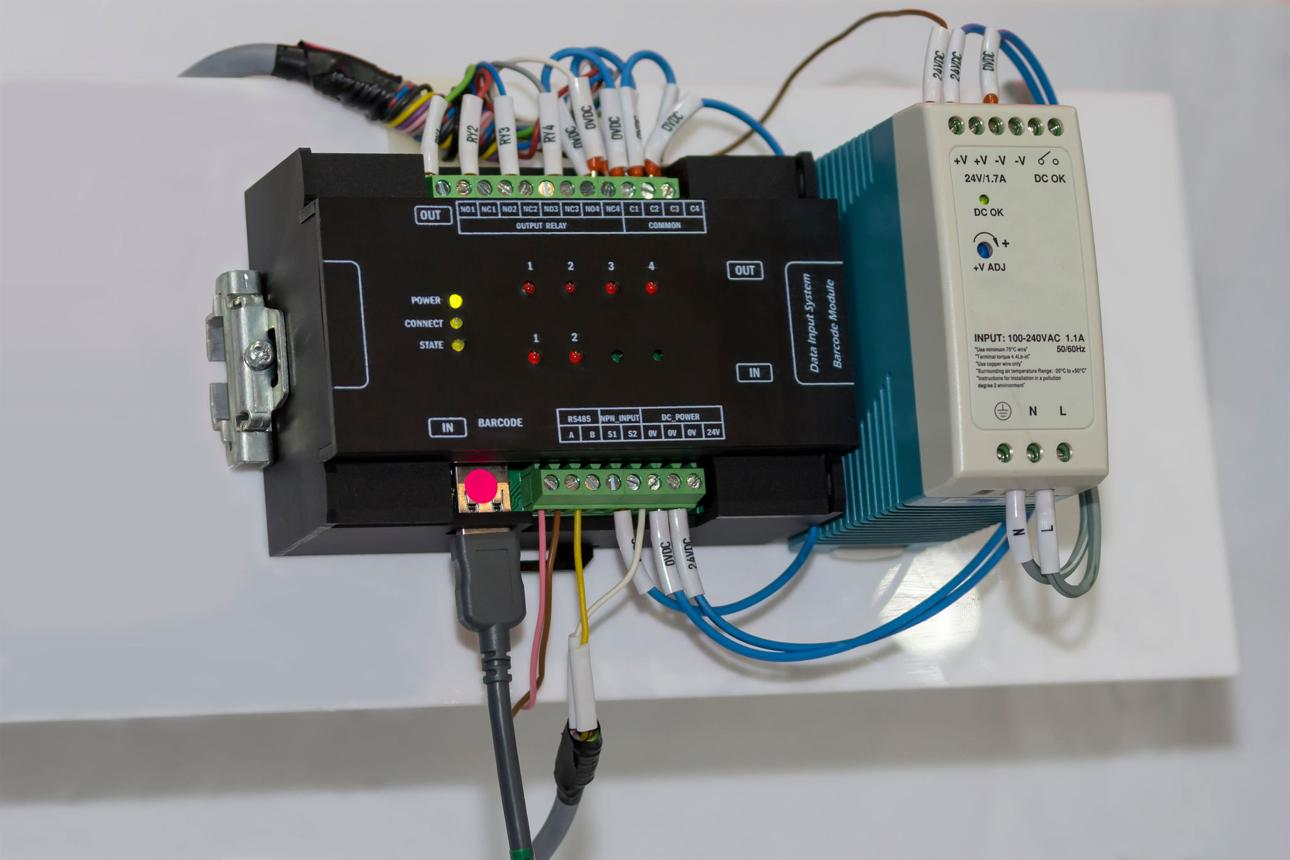
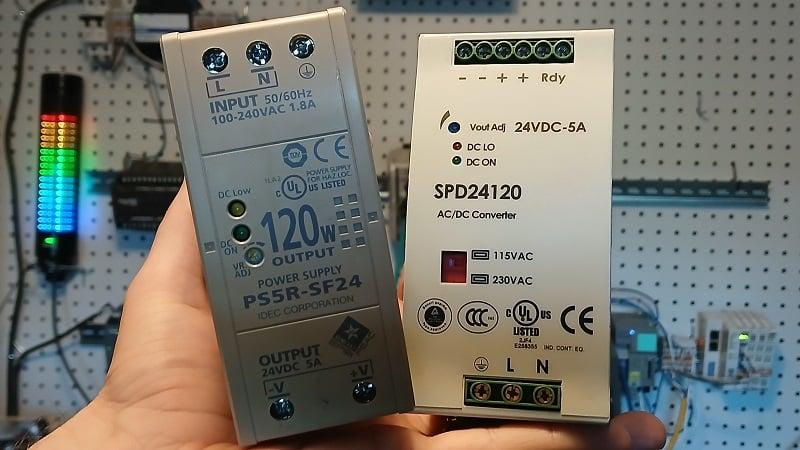
For modern industrial control cabinets, the 24V DIN rail power supply has therefore become one of the most essential infrastructure components.

Modern industrial buyers are also demanding higher performance from switching power supplies than ever before. Stable output voltage, low ripple, high efficiency, compact DIN rail installation, and comprehensive protection functions are now considered standard requirements in industrial automation.
A high-quality industrial switching power supply should include protection features such as over-voltage protection, over-current protection, short-circuit protection, and thermal overload protection. High-efficiency power conversion is equally important because reducing heat generation directly improves long-term reliability and lowers operating cost.
| Industrial Power Supply Type | Typical Efficiency |
| Standard DIN Rail Power Supply | 85%–88% |
| High-Efficiency Industrial Power Supply | 90%–93% |
| Premium Industrial Switching Power Supply | Up to 94% |
Manufacturers such as SIPURUI continue developing advanced 24V industrial switching power supplies specifically optimized for industrial automation environments, helping factories improve reliability while supporting increasingly complex Industry 4.0 systems.

Conclusion
The reason 24V DC became the global standard for industrial automation is not because it offers the highest voltage or the absolute lowest power loss. Instead, 24V DC provides the best overall balance between safety, efficiency, reliability, compatibility, and cost-effectiveness.
Lower-voltage systems such as 12V create excessive current and transmission loss, while higher-voltage systems such as 48V introduce additional safety concerns and higher component costs. In comparison, 24V DC delivers stable performance, manageable current levels, strong anti-interference capability, and excellent compatibility with industrial automation equipment worldwide.
As factories continue moving toward smarter, more connected automation systems, reliable 24V industrial switching power supplies will remain at the center of industrial infrastructure. For machine builders, automation engineers, and industrial equipment manufacturers, choosing a high-quality industrial power supply from an experienced switching power supply manufacturer like SIPURUI remains essential for achieving stable and long-lasting industrial automation performance.