Skip to content


In today’s industrial and electronic systems, power conversion technology plays a far more important role than most people realize. Whether in factory automation, telecommunications infrastructure, renewable energy systems, medical devices, security equipment, or AI computing hardware, every modern electronic system depends on stable and efficient power delivery.
However, many people entering the power electronics industry often become confused by terms such as:
- Switching power supply
- AC-DC power supply
- DC-DC converter
These terms are closely related, but they are not interchangeable.
A common misunderstanding online is to compare AC-DC, DC-DC, and switching power supplies as if they are three completely separate categories. In reality, AC-DC and DC-DC are both types of switching power supplies in most modern applications.
Understanding this relationship is extremely important when selecting industrial power systems, designing electronic equipment, or sourcing reliable power supply products.
This article explains how switching power supplies work, how AC-DC and DC-DC conversion differ, and why switching technology has become the dominant solution in modern industry.
Why Switching Power Supplies Have Become the Industry Standard
Traditional electronic systems once relied heavily on linear power supplies. While linear designs offered relatively simple circuits and low electrical noise, they suffered from major disadvantages that became increasingly problematic as electronic systems evolved.
Linear power supplies generate significant heat because excess electrical energy is dissipated directly through voltage regulation components. As power requirements increase, heat generation becomes difficult to manage, forcing systems to use larger heat sinks, heavier transformers, and bulkier enclosures.
Modern industries, however, require:
- Higher efficiency
- Smaller system size
- Reduced heat generation
- Lower energy consumption
- Higher power density
- Better reliability
This is why switching power supplies have largely replaced linear power supplies across industrial electronics.
Unlike linear designs, switching power supplies use high-frequency semiconductor switching devices to transfer electrical energy efficiently instead of dissipating unused energy as heat.
The result is dramatically improved performance.
| Feature | Linear Power Supply | Switching Power Supply |
| Efficiency | 40–60% | 85–96% |
| Heat Generation | High | Low |
| Size | Large | Compact |
| Weight | Heavy | Lightweight |
| Cooling Requirements | Significant | Reduced |
| Power Density | Low | High |
Because of these advantages, switching power supply technology is now widely used in nearly all industrial electronic systems.
How Does a Switching Power Supply Work?
A switching power supply operates by rapidly switching semiconductor devices ON and OFF at high frequencies. Instead of continuously dissipating energy, power is transferred in controlled pulses through magnetic components such as transformers and inductors.
The basic process typically includes:
- Input filtering
- Rectification
- High-frequency switching
- Energy transfer through magnetic components
- Output rectification
- Voltage regulation and feedback control
Modern switching frequencies often range from tens of kilohertz to several hundred kilohertz. Some advanced Gallium Nitride (GaN) power systems now operate at frequencies above 1MHz.
Higher switching frequency allows transformers and inductors to become much smaller, which significantly reduces system size and weight.
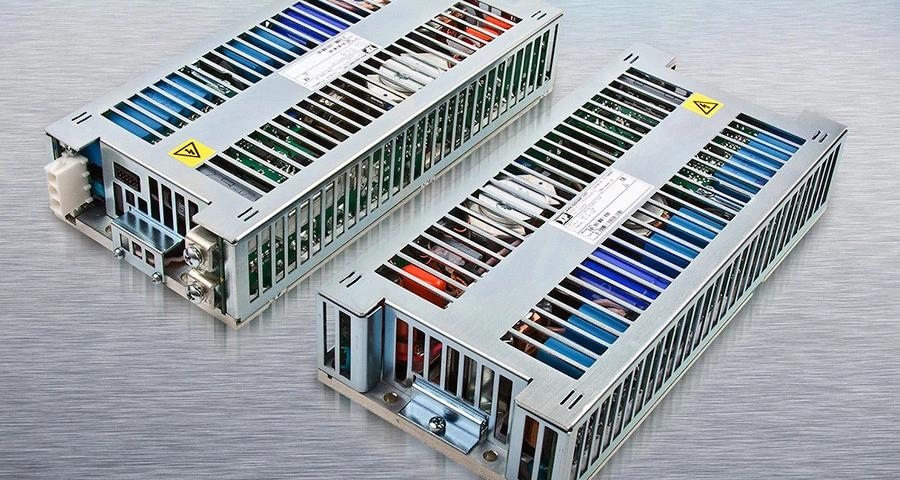
The following image shows the internal structure of a modern industrial switching power supply:

This high-frequency operating principle is the foundation of nearly all modern industrial power systems.
What Is an AC-DC Switching Power Supply?
An AC-DC switching power supply converts alternating current (AC) into regulated direct current (DC).
Since utility grids worldwide provide AC power while electronic systems require DC voltage internally, AC-DC conversion is one of the most important functions in modern electronics.
For example:
- Industrial facilities may use 380V AC or 480V AC
- Commercial power outlets typically provide 110V AC or 220V AC
- Electronic systems internally often require 24V DC, 12V DC, or 5V DC
This means incoming AC electricity must first be converted into stable DC power before electronic equipment can operate properly.
Modern AC-DC switching power supplies achieve this through high-frequency switching topology rather than traditional linear regulation.
The typical conversion process includes:
- EMI filtering
- AC rectification
- Power factor correction (PFC)
- High-frequency switching conversion
- Isolation and voltage transformation
- Output rectification and filtering
The following diagram illustrates a typical AC-DC switching power architecture:

Because of their high efficiency and compact design, AC-DC switching power supplies are now widely used across industrial automation, telecommunications, LED lighting, medical systems, and security infrastructure.
Where Are AC-DC Switching Power Supplies Used?
Modern industrial systems rely heavily on AC-DC switching power supplies because most facilities receive AC power directly from utility grids.
In industrial automation systems, AC-DC power supplies provide regulated 24V DC output for PLC controllers, industrial sensors, servo systems, relays, and communication modules.
In telecommunications infrastructure, high-efficiency AC-DC systems power routers, switches, optical transmission equipment, and base stations. Medical devices also require highly stable AC-DC conversion to ensure operational safety and precision.
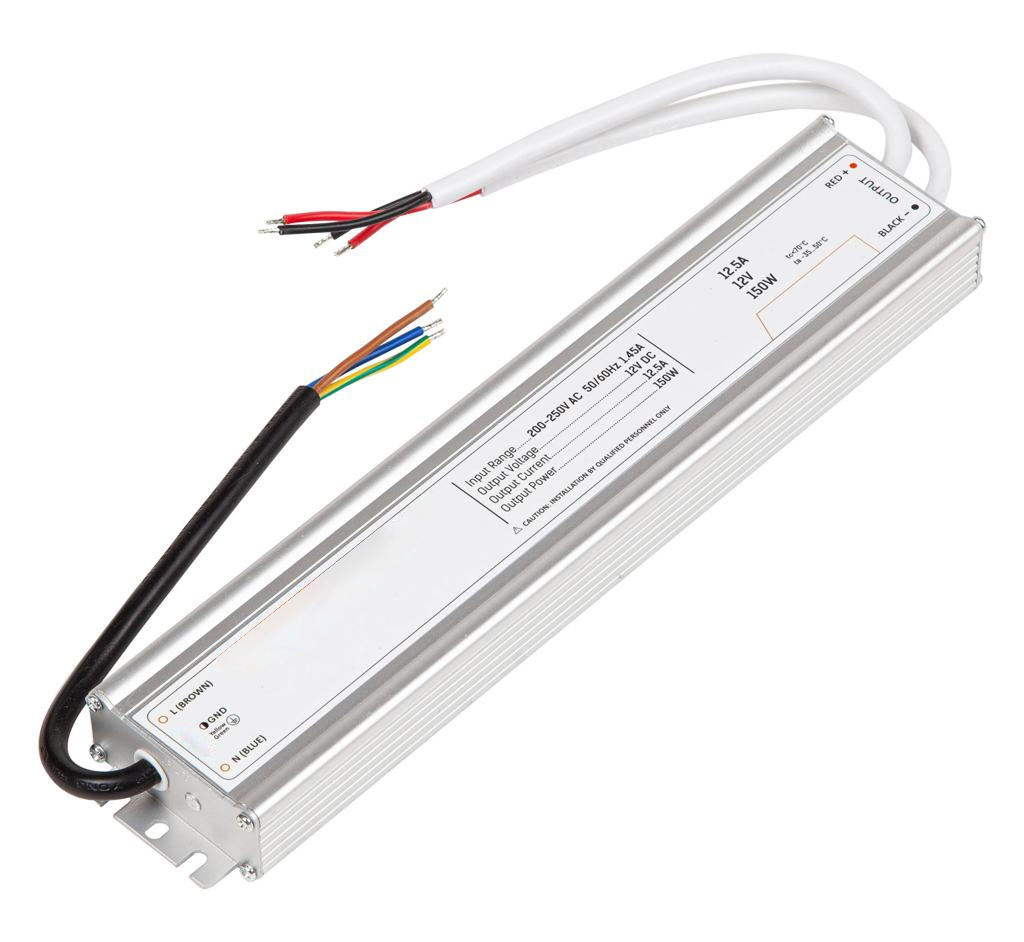
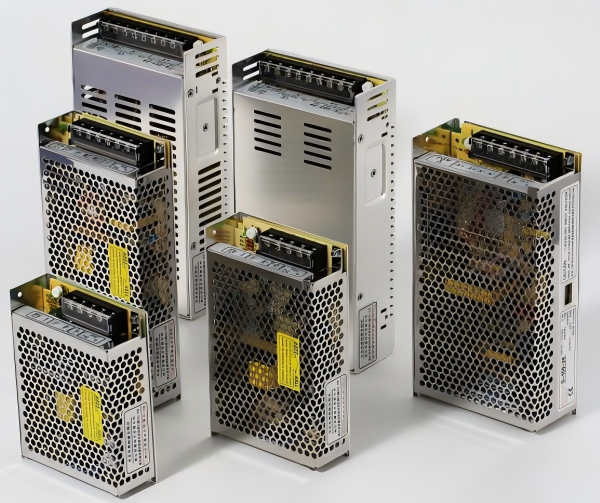
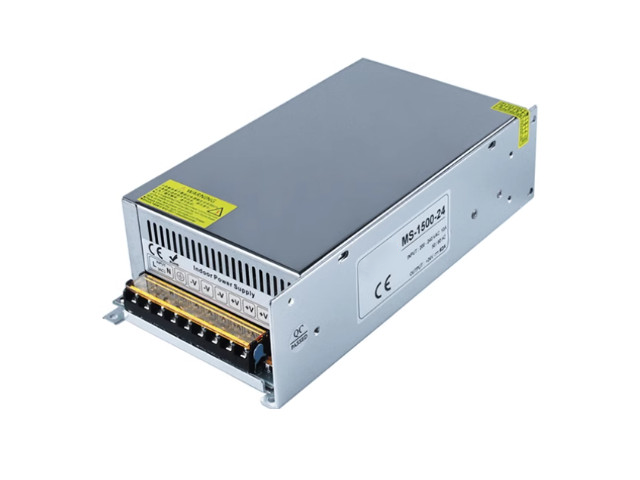
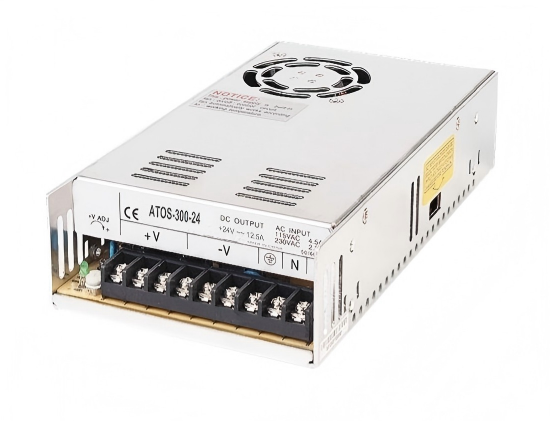
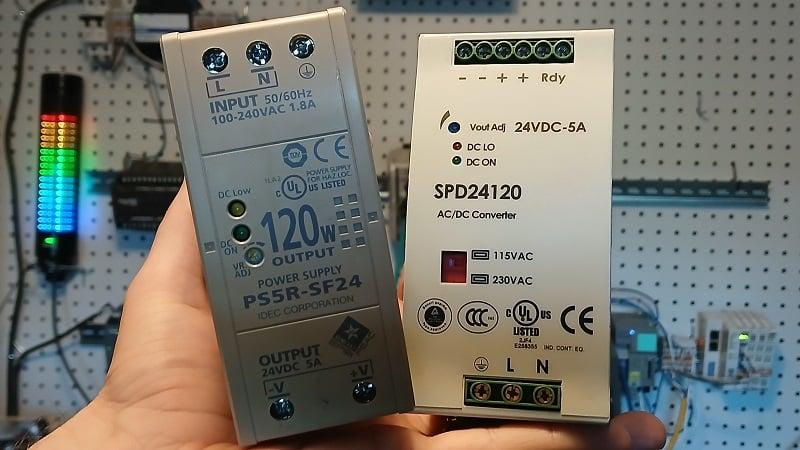
The following examples show common industrial AC-DC switching power supply products:
SIPURUI industrial AC-DC switching power supplies are designed for demanding industrial environments requiring long lifespan, thermal stability, and high conversion efficiency.
Typical SIPURUI AC-DC product categories include:
| SIPURUI Product Series | Main Application |
| DIN Rail Power Supplies | Industrial automation |
| Enclosed Power Supplies | Factory equipment |
| LED Drivers | Lighting systems |
| High-Power AC-DC Supplies | Telecom infrastructure |
| Compact Industrial PSU | Embedded systems |
What Is a DC-DC Converter?
While AC-DC power supplies convert alternating current into direct current, DC-DC converters operate entirely within DC systems.
A DC-DC converter changes one DC voltage level into another DC voltage level.
Examples include:
- 48V DC → 12V DC
- 24V DC → 5V DC
- 12V DC → 48V DC
DC-DC conversion is essential because modern electronic systems rarely operate using only one voltage rail.
A single industrial or electronic system may contain processors, motors, communication chips, cooling systems, sensors, and controllers that all require different operating voltages.
Without DC-DC conversion, modern electronics could not support these complex multi-voltage architectures.
How Do DC-DC Switching Converters Work?
Like AC-DC supplies, modern DC-DC converters also use switching technology.
High-speed switching devices rapidly store and release energy through inductors and transformers while control circuits regulate voltage and current output.
There are several major DC-DC converter topologies commonly used in industrial systems.
Buck Converter
Buck converters reduce voltage from a higher level to a lower level. These are extremely common in industrial control systems and embedded electronics.
Examples include:
- 24V → 12V
- 12V → 5V

Boost Converter
Boost converters increase voltage from a lower level to a higher level.
These are widely used in:
- Battery systems
- LED drivers
- Renewable energy systems
- Portable electronics
Buck-Boost Converter
Buck-boost converters can either increase or decrease voltage depending on input conditions.
These are commonly used in:
- Automotive electronics
- Solar systems
- EV battery management systems
The following images show typical industrial DC-DC converter modules:
SIPURUI DC-DC converter modules are optimized for high reliability, compact integration, low ripple noise, and wide input voltage compatibility.
What Is the Difference Between AC-DC and DC-DC Power Supplies?
Although both belong to the switching power supply category, AC-DC and DC-DC systems perform different functions.
The main difference is the input power type.
| Feature | AC-DC Power Supply | DC-DC Converter |
| Input | AC | DC |
| Output | DC | DC |
| Main Function | Convert grid power | Regulate DC voltage |
| Typical Applications | Industrial equipment | Embedded systems |
| Isolation | Often isolated | Isolated or non-isolated |
| Input Source | Utility grid | Battery or DC bus |
AC-DC supplies are mainly responsible for converting utility AC power into usable DC power, while DC-DC converters distribute and regulate voltage inside electronic systems.
Why Is High Efficiency So Important in Modern Industry?
Efficiency has become one of the most important performance indicators for industrial power systems.
Higher efficiency means:
- Lower electricity consumption
- Reduced cooling requirements
- Lower operating costs
- Improved thermal reliability
- Longer component lifespan
This is especially critical in applications such as:
- AI data centers
- Renewable energy systems
- Industrial automation
- Telecommunications infrastructure
- EV charging systems
Even a small efficiency improvement can generate significant long-term cost savings in large-scale industrial deployments.
Modern industrial switching power supplies can now exceed 95% efficiency under optimized operating conditions.
What Technologies Are Driving the Future of Switching Power Supplies?
The power electronics industry continues evolving rapidly.
Wide-bandgap semiconductors such as Gallium Nitride (GaN) and Silicon Carbide (SiC) are enabling:
- Higher switching frequencies
- Lower switching losses
- Smaller magnetic components
- Higher power density
- Improved thermal performance
At the same time, industrial customers increasingly demand compact power systems capable of delivering more output power within smaller installation spaces.
Digital power management is also becoming more common. Advanced switching power supplies now integrate:
- PMBus communication
- Remote monitoring
- Predictive diagnostics
- Intelligent thermal management
The following images reflect modern industrial switching power supply development trends:
SIPURUI continues developing high-efficiency industrial switching power supplies optimized for automation systems, telecom infrastructure, renewable energy applications, and embedded industrial equipment.

Final Thoughts
Switching power supplies have become the foundation of modern electronic and industrial systems because they provide the efficiency, compact size, and reliability required by today’s applications.
Within the switching power supply category:
- AC-DC power supplies convert AC utility power into DC output
- DC-DC converters regulate and distribute DC voltage within electronic systems
Understanding this relationship is important for selecting the correct power solution for industrial equipment, communication systems, renewable energy infrastructure, and embedded electronics.
As modern industries continue demanding higher efficiency, smaller system size, and smarter power management, advanced switching power technologies from manufacturers like SIPURUI will continue playing a critical role in powering the future of industrial electronics.