Skip to content

Why Are Professional Buyers Paying More Attention to Power Supply Quality?
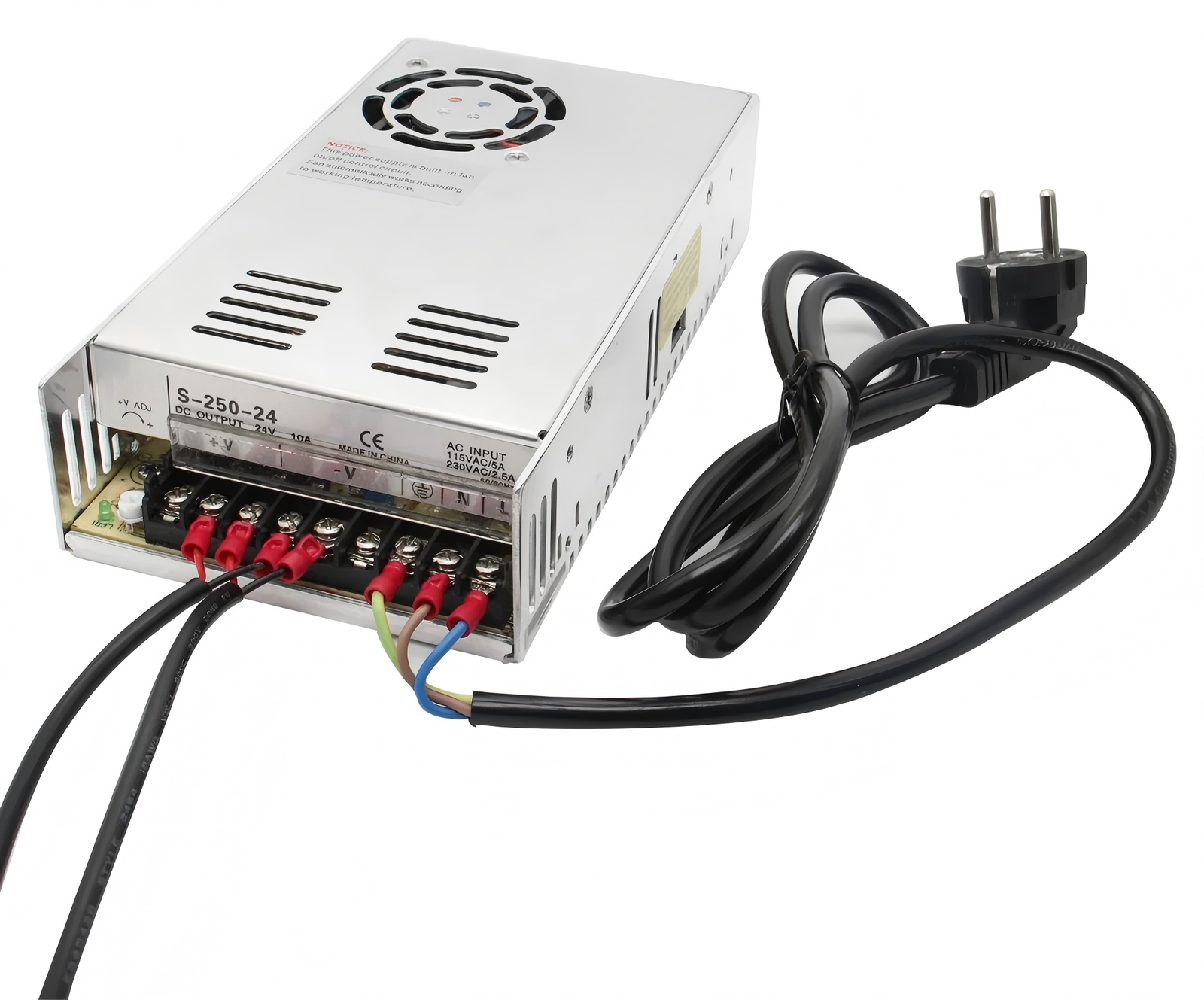
A switching power supply is often one of the least visible components in a finished system, yet it is one of the most critical. Whether installed inside an automation cabinet, CNC machine, telecom rack, LED lighting project, security system, or embedded device, the power supply determines how reliably the entire system performs. When voltage is unstable, heat rises too quickly, or internal components are underspecified, even high-quality equipment can suffer downtime.
Many buyers still compare power supplies only by price, output wattage, or housing size. But experienced procurement teams know that two units labeled 24V 240W may perform very differently in real operating conditions. One may run continuously for years, while another may fail early under heat, dust, or unstable grid conditions. That difference usually comes from design quality, internal components, thermal engineering, and manufacturing consistency.
For OEM manufacturers, project contractors, distributors, and industrial buyers, understanding how a switching power supply works is not just technical knowledge. It is a practical tool for reducing warranty claims, avoiding field failures, and improving total purchasing value. SIPURUI focuses on this practical approach by offering dependable switching power solutions designed for real commercial environments.
What Is a Switching Power Supply and Why Has It Become the Global Standard?

A switching power supply, also known as an SMPS (Switch Mode Power Supply), converts AC input power into regulated DC output power through high-frequency switching technology. Unlike traditional linear power supplies that rely on large low-frequency transformers, switching designs use power transistors that turn on and off rapidly. This high-speed conversion allows the transformer to be much smaller while improving efficiency and reducing wasted energy.
That is why switching power supplies have become the standard choice in modern electronics. They are lighter, more compact, more efficient, and easier to integrate into enclosed equipment. In industrial applications where cabinet space is valuable and heat control matters, these advantages are significant.
Typical outputs include 12V for CCTV and LED systems, 24V for automation and PLC equipment, and 48V for telecom and networking systems. Because these voltage standards are used globally, switching power supplies are now found in nearly every modern commercial sector.
Switching Power Supply vs Linear Power Supply
| Feature | Switching Power Supply | Linear Power Supply |
| Efficiency | 85%–95% | 40%–60% |
| Size | Compact | Large |
| Weight | Light | Heavy |
| Heat Output | Low | High |
| Input Voltage Range | Wide | Narrow |
| Best Use | Industrial / OEM | Specialty Low Noise |
How Does a Switching Power Supply Actually Work Inside?
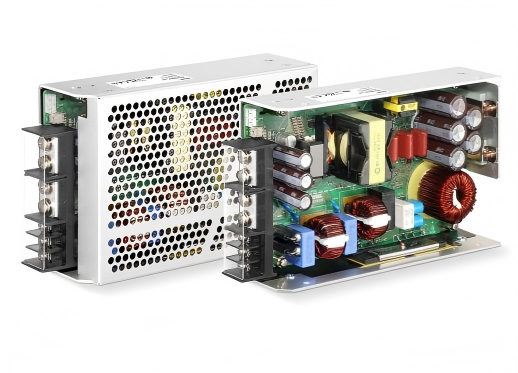
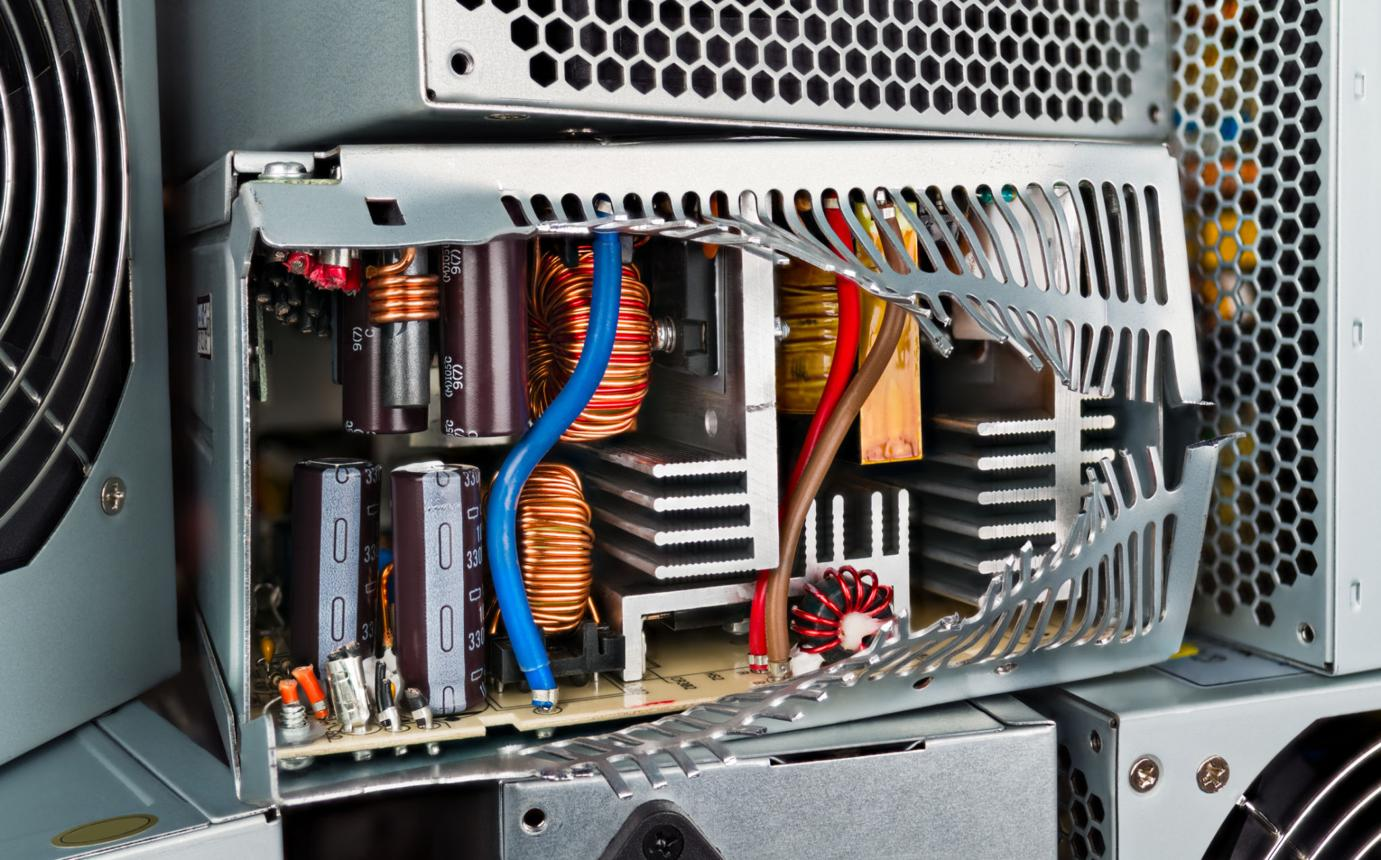
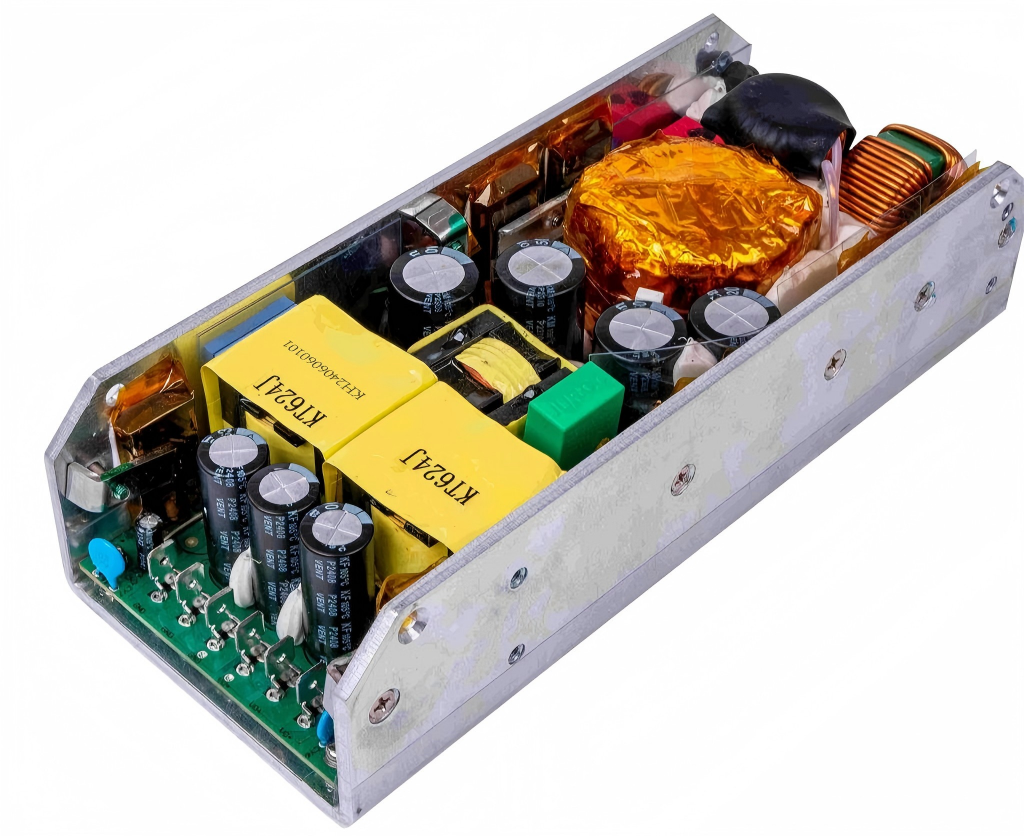
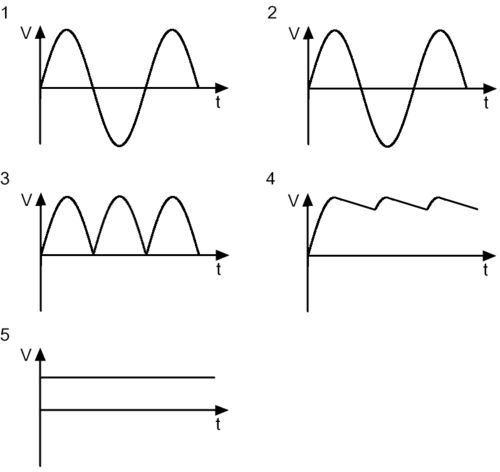
Although internal circuit topologies can vary by model and power range, most switching power supplies follow the same fundamental operating path. Incoming AC power first enters an EMI filter stage. This section reduces conducted noise, suppresses surge spikes, and helps the unit meet EMC compliance requirements. Quality designs usually include a fuse, MOV varistor, X capacitors, Y capacitors, and common mode choke. These components may not attract attention on a specification sheet, but they are often the first sign of a serious product.
After filtering, the AC voltage passes through a bridge rectifier where it is converted into high-voltage DC. Large electrolytic capacitors then smooth the waveform and store energy for the next stage. At this point, the power supply has prepared stable DC energy but has not yet created the low-voltage output used by the equipment.
The next stage is where switching technology creates its main advantage. Power MOSFETs switch on and off rapidly, often tens of thousands of times per second, generating a high-frequency waveform that feeds the transformer. Because the frequency is so much higher than mains frequency, the transformer can be smaller, lighter, and more efficient than the transformer used in a linear design.
The transformer then performs two critical tasks at once. It changes voltage levels and provides electrical isolation between the input side and the output side. This isolation is especially important in industrial systems where operator safety and equipment protection are essential.
Finally, the transformed voltage is rectified again and filtered through inductors and capacitors to create clean, stable DC output. A control IC continuously monitors the output and adjusts switching behavior through PWM regulation so that voltage remains stable even when load demand changes suddenly.

Why Does PFC Matter More Than Many Buyers Realize?
Power Factor Correction, usually called PFC, is often overlooked during purchasing discussions, yet it has major practical value. PFC improves the way a power supply draws current from the AC line. Better power factor generally means improved efficiency, reduced harmonic distortion, and better compatibility with international energy requirements.
Modern active PFC designs are especially useful for export-oriented products because they usually support universal 100–240VAC input. This means the same unit can be used in North America, Europe, Asia, and many other regions without manual voltage selection. For companies shipping products globally, this simplifies inventory management and reduces model complexity.
Low-cost legacy products may still use no PFC or passive PFC, but active PFC is widely considered the professional standard for industrial and commercial power supplies in 2026.
Comparison of PFC Types
| Type | Efficiency | Input Flexibility | Typical Market |
| No PFC | Low | Limited | Low-end legacy |
| Passive PFC | Medium | Moderate | Older mid-range |
| Active PFC | High | Wide | Modern professional |
Why Do Two Power Supplies With the Same Wattage Perform Differently?
This is one of the most important questions a buyer can ask. Wattage labels alone do not reveal how a unit behaves under real conditions. Continuous output capability, thermal derating, ripple control, startup behavior, and component lifespan all matter.
A quality power supply typically uses 105°C rated capacitors, better MOSFET safety margins, properly sized magnetic components, and efficient heat dissipation paths. These design choices allow stable operation in enclosed cabinets, elevated ambient temperatures, and long-duty-cycle environments.
Lower-cost products may still function in light-duty use, but they often run closer to component limits. Over time, this can accelerate capacitor aging, increase ripple noise, and reduce service life. For buyers, the cheapest initial quote can become the most expensive option after field replacements and downtime are considered.

Which SIPURUI Product Series Should You Choose?
The correct power supply depends heavily on application environment, mounting method, and load profile. SIPURUI offers several practical categories designed around common industrial needs.
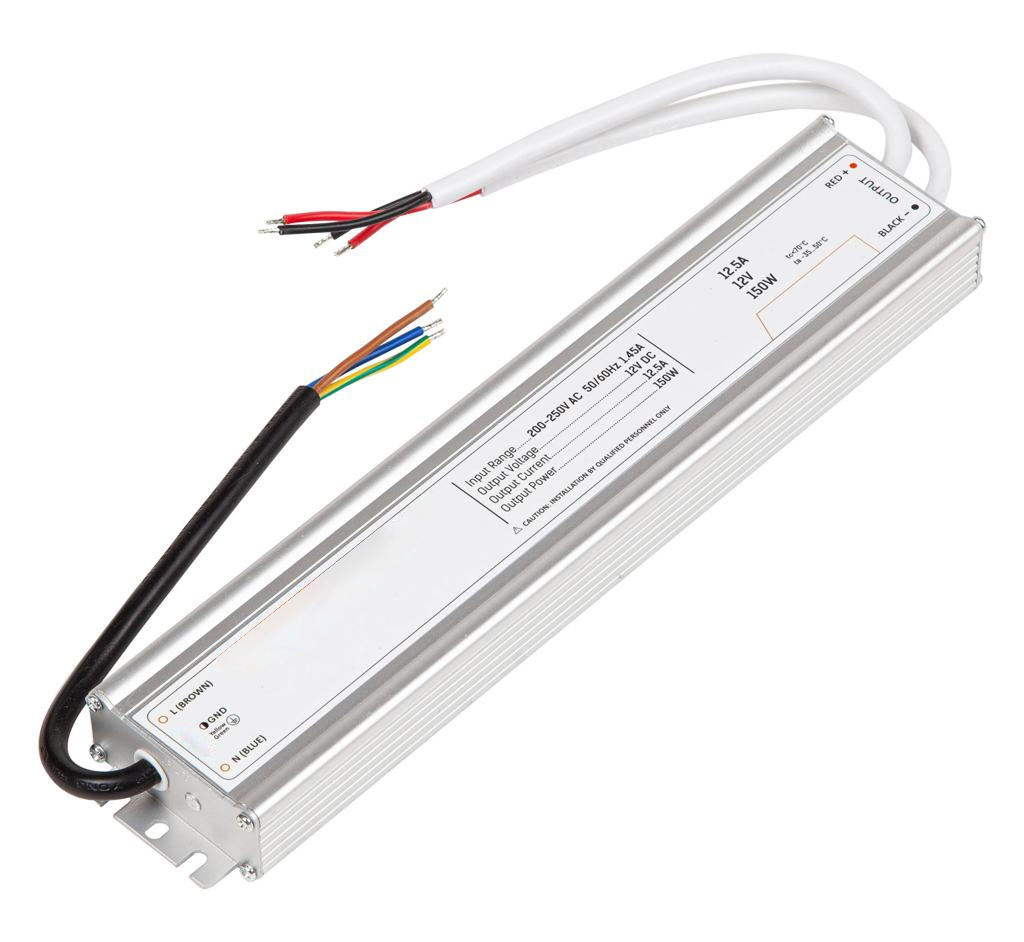
Enclosed metal-case models are popular for machines, control cabinets, and OEM equipment where ventilation exists and cost-performance balance matters. DIN rail models are preferred in PLC panels and automation systems because they simplify installation and service replacement. Waterproof IP-rated models are ideal for outdoor LED signage, landscape lighting, and humid environments. Open-frame designs are often selected by OEM manufacturers integrating power supplies into their own housings.
Typical Product Selection Guide
| SIPURUI Series | Typical Output | Best Application | Main Advantage |
| Enclosed Series | 12V / 24V / 48V | Machines & Cabinets | Strong value |
| DIN Rail Series | 24V / 48V | PLC Systems | Easy installation |
| Waterproof Series | 12V / 24V | Outdoor Projects | Weather resistance |
| Open Frame Series | Custom | OEM Integration | Compact size |
| High Power Series | 24V 600W+ | Motors / Heavy Load | Thermal strength |
How Much Power Margin Should Serious Buyers Leave?
Selecting a power supply equal to exact system load is usually not ideal. If a device continuously requires 180W, using a 180W unit leaves little headroom for startup surge, future expansion, or high ambient temperature. Many professional buyers choose a reasonable safety margin to improve long-term reliability.
For example, a 90W load may be better served by a 120W or 150W unit. A 350W system may perform more reliably with a 450W or 600W model depending on operating environment. This additional margin often lowers internal stress, reduces fan noise in cooled models, and extends component lifespan.
The best choice depends on duty cycle, cabinet airflow, and ambient temperature rather than wattage alone.
What Certifications Should You Request Before Ordering?
For export and commercial projects, documentation matters almost as much as hardware quality. Depending on market destination, buyers often request CE, UL or ETL, FCC, RoHS, CB, or other applicable certifications. It is wise to ask for current documents tied to the actual model being purchased rather than relying on outdated certificates or unrelated references.
A serious supplier should also be able to discuss lead time stability, revision control, labeling options, packaging standards, and after-sales support procedures.
Why Are More OEM and Industrial Buyers Choosing SIPURUI?
Procurement decisions today are based on more than price. Buyers want stable quality, repeatable delivery, responsive communication, and products designed for real working environments. SIPURUI focuses on these priorities with a product range covering common 12V, 24V, and 48V industrial requirements, along with multiple housing formats for OEM and project use.
For many customers, the real value comes from consistency. Receiving the same dependable product specification across repeat orders can be more important than saving a small amount on unit price.

Final Thoughts: Is the Lowest Price Really the Best Purchase?
In many cases, no. A failed power supply can stop production lines, interrupt installed systems, create emergency service calls, and damage customer confidence. That is why experienced buyers evaluate total ownership cost rather than invoice price alone.
When sourcing your next switching power supply, focus on continuous output capability, thermal reliability, regulation quality, protection functions, certification readiness, and supplier consistency. These are the factors that determine long-term value.
If your company is seeking dependable industrial power solutions in 2026, choosing a professional supplier such as SIPURUI can be the smarter strategic decision.