Skip to content


In today’s power electronics industry, switching power supplies are expected to deliver far more than basic voltage conversion. Modern applications require higher efficiency, smaller size, lower heat generation, and longer operational lifespan. Whether in industrial automation systems, telecom infrastructure, LED lighting, medical equipment, or server power supplies, engineers are constantly pushing switching frequencies higher in order to increase power density and reduce overall system size.
However, as switching frequencies continue to rise, one hidden challenge becomes increasingly difficult to control: magnetic core loss.
Unlike visible components such as MOSFETs or capacitors, magnetic components often receive less attention during early-stage design. But in reality, transformers and inductors are among the most critical heat-generating parts inside a high-frequency switching power supply. If magnetic losses are not properly optimized, the entire system may suffer from excessive temperature rise, unstable efficiency, stronger EMI, and reduced long-term reliability.
A typical high-frequency transformer used in modern industrial switching power supplies must operate continuously under rapidly changing magnetic fields while maintaining thermal stability and electrical efficiency.

This is why reducing magnetic core loss has become one of the most important engineering tasks in modern SMPS development.
What Is Magnetic Core Loss and Why Does It Matter?
Magnetic core loss refers to the energy dissipated inside transformer and inductor cores during operation. Unlike copper loss, which comes from wire resistance, magnetic loss occurs directly inside the magnetic material itself as it repeatedly responds to alternating magnetic fields.
In high-frequency switching power supplies, magnetic core loss mainly consists of two components:
| Loss Type | Main Cause | Impact on SMPS |
| Hysteresis Loss | Continuous magnetic domain switching | Heat generation |
| Eddy Current Loss | Internal circulating currents inside the core | Efficiency reduction |
As switching frequency increases, both types of losses rise significantly. In low-frequency designs, these losses may remain relatively small. But in modern high-density power supplies operating above 100kHz, magnetic loss can become one of the largest sources of internal heat.
This is particularly important because excessive transformer temperature does not only affect the magnetic component itself. It also impacts nearby electrolytic capacitors, semiconductors, and PCB reliability. In long-term industrial applications operating 24/7, even a moderate increase in internal temperature can shorten product lifespan dramatically.
That is why professional power supply manufacturers such as SIPURUI place heavy emphasis on magnetic optimization during the design process.
Why Are Ferrite Cores Widely Used in High-Frequency SMPS?
Choosing the correct magnetic material is one of the most important decisions in switching power supply design. Different magnetic materials behave very differently under high-frequency conditions, especially when thermal performance becomes critical.
Today, ferrite remains the most commonly used material for high-frequency transformers because it offers very low eddy current loss and excellent electrical resistance. Compared with traditional iron powder cores, ferrite materials generate significantly less heat during high-frequency switching operation.
This makes ferrite especially suitable for:
- Flyback transformers
- LLC resonant converters
- Forward converters
- Telecom power supplies
- Industrial DIN rail power supplies
Different magnetic materials also provide different tradeoffs between efficiency, saturation capability, and cost.
| Core Material | Main Advantage | Typical Application |
| Ferrite Core | Excellent high-frequency efficiency | High-frequency transformers |
| Iron Powder Core | Lower cost | PFC inductors |
| MPP Core | Extremely low loss | Precision industrial SMPS |
| Sendust Core | Balanced performance | Output inductors |
The structural differences between these magnetic materials can also directly influence transformer size, temperature rise, and overall system efficiency.
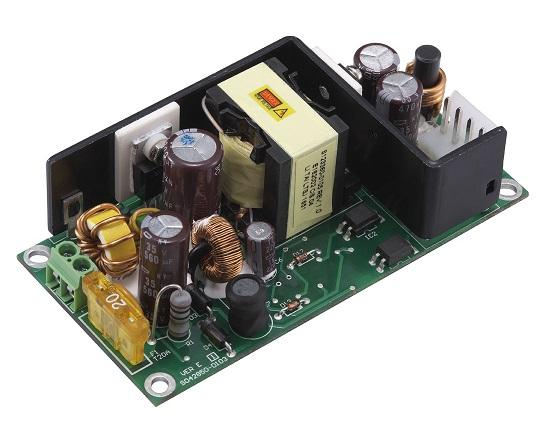
For high-efficiency SIPURUI switching power supplies, optimized ferrite structures are commonly selected because they provide an excellent balance between thermal performance, switching efficiency, and long-term reliability.
Why Does Higher Switching Frequency Increase Core Loss?
One of the biggest trends in modern SMPS design is increasing switching frequency. Higher frequency allows engineers to reduce transformer size, lower magnetic component weight, and improve overall power density.
This is why many modern switching power supplies now operate at frequencies such as:
- 65kHz
- 100kHz
- 250kHz
- Even above 500kHz in advanced GaN systems
However, increasing frequency also places much greater stress on the magnetic core.
As the magnetic field changes polarity more rapidly, magnetic domains inside the ferrite material must continuously realign themselves. At the same time, rapidly changing magnetic flux generates stronger internal circulating currents inside the core material itself. Together, these effects produce significant heat generation.
Without proper magnetic optimization, transformer temperature can rise rapidly under full-load operation.
This creates a major engineering challenge. Designers must carefully balance:
- Efficiency
- Thermal behavior
- Transformer size
- EMI performance
- Product cost
- Long-term reliability
instead of simply pushing switching frequency higher.
How Do Engineers Actually Reduce Magnetic Core Loss?
Professional SMPS engineers use several methods simultaneously to reduce transformer heating and improve efficiency.
One of the most effective methods is lowering magnetic flux density inside the transformer core. Lower magnetic stress generally means lower internal heating. Engineers achieve this by increasing transformer turns, optimizing duty cycles, reducing ripple current, or selecting slightly larger core sizes.
Although larger magnetic cores may slightly increase material cost, they often improve thermal performance and reliability significantly.
Transformer winding structure is also extremely important. Poor winding layout can create excessive AC resistance, leakage inductance, and additional hot spots inside the transformer. These problems not only reduce efficiency but also worsen EMI performance.
To improve magnetic efficiency, modern switching power supplies increasingly use advanced winding techniques such as:
- Interleaved winding
- Multi-layer winding
- Litz wire structures
- Planar transformer designs
Among these technologies, planar transformers are becoming particularly popular in compact high-power applications because they offer lower leakage inductance, improved airflow, and better thermal distribution.
Modern planar transformer structures are now widely used in:
- Telecom rectifiers
- Server power supplies
- GaN chargers
- High-density industrial SMPS systems

Compared with traditional transformers, planar magnetic structures also provide more consistent manufacturing quality and improved cooling capability in compact enclosures.
Why Is Thermal Management Still Essential?
Even low-loss magnetic materials still generate heat during operation. Without effective thermal management, excessive transformer temperature can gradually damage nearby components and reduce system reliability.
For this reason, thermal optimization remains a critical part of industrial switching power supply design.
Professional SMPS cooling strategies often include optimized airflow paths, larger PCB copper areas, thermal interface materials, aluminum heat sinks, and ventilated enclosure structures.
During development, engineers frequently use thermal imaging cameras to identify transformer hot spots and improve cooling performance before mass production begins.
In high-power industrial systems operating continuously for years, good thermal design is often just as important as electrical efficiency itself.

The Future of Low-Loss Switching Power Supplies
As GaN and SiC semiconductor technologies continue evolving, switching frequencies will become even higher in future power supply platforms. This will make magnetic optimization more important than ever before.
Future low-loss switching power supplies will increasingly rely on:
- Advanced ferrite materials
- Planar magnetic technologies
- AI-assisted thermal simulation
- High-density cooling systems
- Intelligent magnetic optimization
Manufacturers capable of controlling magnetic losses effectively will gain major advantages in efficiency, product lifespan, thermal stability, and power density.
At SIPURUI, magnetic optimization remains one of the key technologies behind high-efficiency industrial switching power supplies designed for demanding long-term applications.